Cascadia builds, replaces, and completes selected repairs on residential decks in Bothell. The estimate should identify whether the work is new construction, replacement, expansion, or a limited repair. Height above grade, what sits below the deck, setbacks, stairs, guards, drainage, and the house connection shape the next steps.
The Bothell service-area overview covers both deck and fence work, and the Bothell fence contractor page handles fence projects. This page focuses on the deck decision and what the Bothell Municipal Code publishes.
Bothell’s exemption has three conditions and no size cap
Bothell Municipal Code 20.02.095 exempts from a building permit those sidewalks, decks, and driveways associated with residential structures built under the residential code that are not more than 30 inches above grade, not over any basement or story below, and not part of an accessible route.
All three conditions have to be true. Height alone does not settle the answer, and a deck over a basement needs a permit even at a low height.
One detail separates Bothell from several neighbors. The Bothell exemption contains no square-footage cap. Bothell adopts the 2021 residential code while excluding its Chapter 1, which is where the model permit-exemption list with its area limit lives, so the city runs its own exemption text instead. Do not assume a 200 square foot rule applies here.
How far a deck can reach into a setback
Bothell publishes a projection rule that turns on the same 18 inch line. Uncovered porches and decks that exceed 18 inches above finished grade may project 18 inches into side and rear yard setbacks and 36 inches into the front yard setback. Uncovered porches and decks not exceeding 18 inches above finished grade may project to the property line.
Base residential setbacks come from the zone. In the code table the front yard is 15 feet in R-C, R-L1, and R-L2 and 10 feet in the R-M zones, with 20 feet in front of a garage door, and the side yard is 5 feet across the residential zones. Rear yard values vary by zone and by whether an alley is present.
Confirm the zone before drawing a footprint. A design that works in one Bothell zone can fail the setback in another.
Coverage is counted in two separate ways
Bothell states directly that decks are exempted from the building coverage provisions. That is a real advantage over cities that count an elevated deck toward lot coverage.
Hard surface coverage is calculated separately and is capped by zone, at 35 percent in R-C, 55 percent in R-L1, 60 percent in R-L2, and higher percentages in the R-M zones. Permeable pavement and vegetated roofs count only 50 percent of their site area. The city’s impervious surface definition names roofs, walkways, patios, driveways, and similar surfaces and does not name decks, so how a specific deck is counted is a city determination.
Critical areas, slope, and trees
Buildings and other structures must be set back 15 feet from the edges of all critical area buffers, or from the edges of critical areas where no buffer is required. Bothell allows certain features within that setback, including landscaping, uncovered decks, building overhangs limited to 18 inches, and impervious surfaces such as driveways and patios, subject to water quality regulations.
Landslide hazard criteria in the code include slopes steeper than 15 percent with specified subsurface conditions, any area with a slope of 40 percent or steeper with a vertical relief of 10 or more feet, and slopes steeper than 80 percent subject to rock fall during seismic shaking. Stream and wetland buffers are set separately and can be substantial.
Tree retention requirements do not apply to existing individual single-family dwellings on lots of record 20,000 square feet or less in area. A significant tree is defined as over eight inches in diameter measured four feet above grade within the net buildable area.
Decide what can remain in a replacement
An older deck can need new surface boards, structural repair, or full replacement. A site review should look at accessible framing, footings, posts, beams, joists, the ledger or other house connection, stairs, guards, drainage, movement, and visible decay.
Concealed conditions may not be known before demolition. A useful scope states what was inspected, what is assumed to remain, and how unexpected damage will be handled. The deck repair and replacement guide explains why a surface-only request still needs a look below the boards.
Compare cedar and composite on the same layout
Cedar is a wood surface whose color and finish depend on exposure and care. Composite reduces routine staining and sealing, but each board line has its own installation and cleaning instructions. The structure, drainage, stairs, and guards need the same attention either way.
Compare both materials against one footprint and railing plan, including fascia, stair treads, exposed edges, and transitions at the home. Review the cedar deck service and the composite deck service before choosing a surface.
A Cascadia deck example
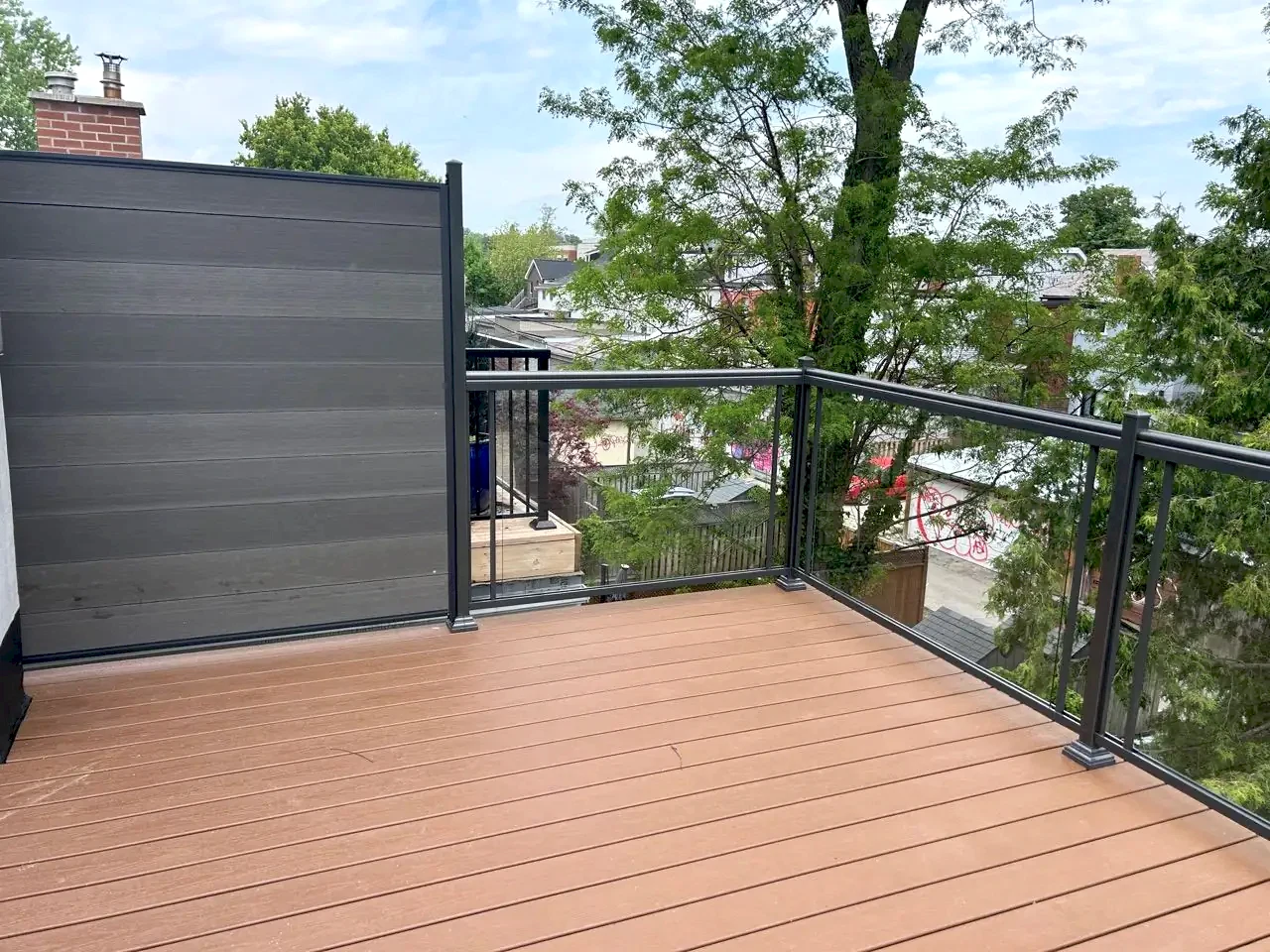
The project image on this page is Cascadia work. Its location is not published, and it is not presented as a Bothell project. The related composite deck rebuild shows how a replacement changes framing, edges, and stair planning.
The example shows the service. It does not establish a Bothell address, permit history, customer, price, product specification, or completion date.
What to send for a Bothell deck estimate
- The address or ZIP code and a short description of what should change
- Approximate length, width, and height at the high and low sides
- Whether anything sits below the deck, including a basement, story, or crawl space
- Photos of the house connection, supports, ground, stairs, railing, and access
- Any available survey, easement, HOA rule, critical-area record, or permit history
- Which existing parts you hope to keep and where damage is visible
Bothell deck questions
Is there a square-footage limit on the Bothell exemption?
The city’s exemption text does not contain one. It turns on height above grade, whether anything sits below, and whether the deck is part of an accessible route. The city decides how it applies to a specific project.
Does my deck count against lot coverage?
Bothell states that decks are exempted from the building coverage provisions. Hard surface coverage is calculated separately and is capped by zone, and whether a given deck counts there is a city determination.
How far can the deck extend into the setback?
An uncovered deck above 18 inches may project 18 inches into side and rear setbacks and 36 inches into the front setback. Below 18 inches it may project to the property line.
Can Cascadia decide whether the old frame can stay?
Cascadia can assess visible and accessible conditions for an estimate. Concealed damage may change the recommendation once work begins, so the scope should identify what was confirmed.
Cascadia Deck & Fence LLC is a Washington contractor, registration CASCADF741LJ, and is licensed, bonded, and insured. Free estimates are available. Workmanship warranty options up to four years are available with select packages and must be documented in the written agreement.
Read the regional permit research guide, then request a free Bothell deck estimate with wide and close photos.